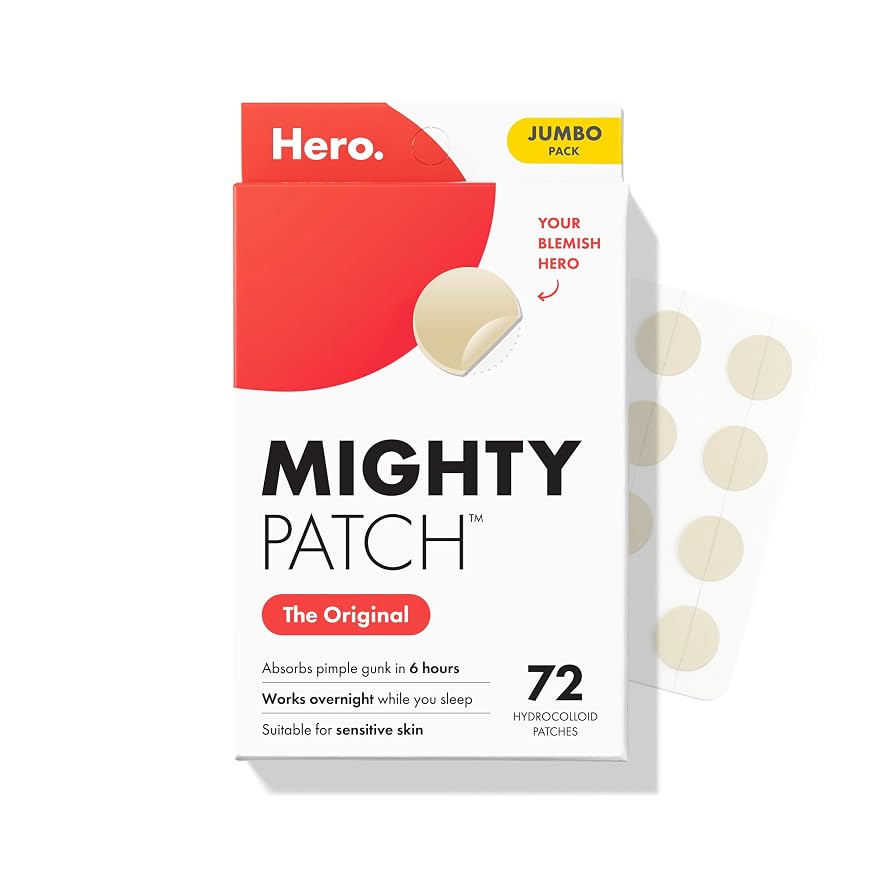
I have a confession: before I tried the Hero Cosmetics Mighty Patch, I thought hydrocolloid patches were all marketing. I'd used the cheap drugstore blister bandages cut into tiny squares, I'd tried random Korean brand knockoffs from Amazon, and I'd convinced myself that the difference between a $6 patch and a $13 patch was purely aesthetic. The packaging is nicer, the patches are cuter, everything else is the same. Right?
Wrong. Dead wrong. After two weeks of using the Mighty Patch — the original, the one that started the hydrocolloid acne patch craze — I understand why this specific product has over five thousand five-star reviews, why it's the best-selling acne patch in the US, and why I'll never go back to my DIY blister bandage approach. The Mighty Patch is one of those rare products that justifies its hype entirely through execution. It's not doing anything revolutionary on paper — it's just doing the simple thing better than everyone else.
Let me walk you through why.
Brand & Product Context
Hero Cosmetics was founded in 2017 by a husband-and-wife team, Dwight and JuEun Lee, with a simple premise: acne care should be simple, effective, and not make you feel like you're treating a disease. The brand's first product was the Mighty Patch, and it launched on Shark Tank in 2019. The pitch was straightforward — a hydrocolloid patch that sucks gunk out of pimples while you sleep — and it resonated immediately. The company reportedly generated over $30 million in revenue in its first few years, and in 2023, the brand was acquired by Church & Dwight (the parent company of Arm & Hammer, OxiClean, and Trojan). That's a big corporate exit for a product that's essentially a sticker that absorbs fluid.
But here's the thing: the Mighty Patch isn't just a sticker. Hero Cosmetics has released multiple variations since — the Invisible+ Patch (thinner, more discreet for daytime wear), the Micropoint for Dark Spots (with niacinamide-infused microdarts), the Nose Patch, the Body Patch, the Day + Night combo pack, and the Mighty Patch for Early-Stage Blemishes (a smaller, more targeted version). The original Mighty Patch remains the flagship, and it's the one I tested for this review. It's the nighttime patch, designed to be worn for 6–8 hours, typically while you sleep.
The Mighty Patch Original comes in a bright orange box — 36 circular patches (12mm diameter) in a single pack. There's also a 72-count variant for those who go through them faster. Each patch is a small, translucent circle on a peel-off liner, designed to be applied directly over a whitehead or inflamed pimple. The ingredient list is laughably short: one ingredient. Hydrocolloid. That's it. There's no salicylic acid, no tea tree oil, no niacinamide, no active ingredients — just medical-grade hydrocolloid, which is the same material used in wound dressings for burn victims and post-surgical recovery.
How Hydrocolloid Actually Works
Let's geek out for a second about the actual mechanism, because understanding it explains why the Mighty Patch works and why not all patches are created equal. Hydrocolloid is a gel-forming polymer — typically a combination of pectin, gelatin, and carboxymethylcellulose — that's designed to absorb exudate (fluid) from wounds. When you apply it to a pimple, it creates a moist, sealed environment that draws fluid out of the lesion through osmosis. The patch turns white as it absorbs, and the white color is actually the hydrocolloid particles swelling with the absorbed fluid. The more fluid it absorbs, the whiter the patch gets.
This is why hydrocolloid patches work best on whiteheads and pimples that have come to a head. If the pimple is deep, cystic, or hasn't surfaced yet, there's nothing for the patch to absorb. The patch creates a physical barrier that prevents you from picking at the spot, which is genuinely helpful, but the active absorption only works when the blemish is already at the surface. This is a point most people miss — the Mighty Patch is not a treatment for acne, it's a management tool for active breakouts.
The key difference between medical-grade hydrocolloid (what Hero uses) and the stuff you find in cheap blister bandages is purity and thickness. Medical-grade hydrocolloid is formulated to be sterile, consistent, and to maintain its structural integrity as it absorbs fluid. Cheap hydrocolloid can break down, turn into a sticky mess, or lose adhesion as it absorbs. The Mighty Patch stays intact, stays in place, and peels off cleanly, which is a lot harder to engineer than it sounds.
Texture & Application Experience
The Mighty Patch is a thin, translucent circle about the size of a nickel. It comes on a glossy backing sheet that you peel off, revealing the slightly tacky adhesive side. The patch itself is flexible — it conforms to the curve of your nose, chin, forehead, wherever you put it. The adhesive is strong enough to stay on through a full night's sleep, including tossing and turning, pillow friction, and morning face-washing, but gentle enough to remove without pulling your skin or causing irritation.
Applying it is straightforward: cleanse your face, dry the area thoroughly, peel the patch from the liner, and press it onto the blemish. The patch should be centered over the whitehead with the edges extending about 2–3mm past the pimple's perimeter. It's important that the skin is completely dry — if there's any moisture, the adhesive won't form a proper seal and the patch will fall off during the night.
One thing I noticed immediately: the Mighty Patch is invisible enough to wear during the day if you're not self-conscious. It's not completely invisible — it's a translucent circle, so it's noticeable if someone looks closely — but it's much less obvious than the thick, opaque patches I've used from other brands. The Invisible+ variant is thinner and more discreet, but even the Original is surprisingly subtle. I wore one to the grocery store on a Saturday morning and nobody stared at me. Your mileage may vary depending on how observant your local grocery shoppers are, but it's a passable daytime patch in a pinch.
The patch stays in place remarkably well. I tested it through a night of sleep, a morning workout, and a shower (I kept it on through the shower, not recommended, but I wanted to see if it would stay). It stayed on through all three, though the adhesive was noticeably weaker after the shower. For a six-hour wear, the patch maintained its adhesion perfectly. For a full eight-hour sleep, it was still firmly in place when I woke up.
Two-Week Wear Test
Skin context: I'm combination-oily with occasional hormonal breakouts — typically one to three active whiteheads on my chin and jawline around my cycle, plus the occasional stress-induced pimple on my forehead. I don't have severe acne, but I do get the kind of breakouts that are annoying enough to make me want to pick at them, which is exactly the wrong thing to do. During the test period, I used the Mighty Patch on every whitehead that appeared, day or night, and tracked how quickly each blemish resolved compared to my usual routine (which involves a spot treatment with benzoyl peroxide).
Days 1–3: The first breakout of the test period was a classic whitehead on my chin that appeared on a Monday morning. I applied a Mighty Patch after my morning cleanse, wore it for about six hours during the workday (I work from home, so nobody saw it), then replaced it with a fresh one before bed. The morning after, the patch was visibly white in the center — it had absorbed a noticeable amount of fluid. The whitehead was significantly flatter and less angry-looking. Not completely gone, but the difference was striking. I peeled off the patch, did my morning routine, and applied a fresh patch. By the next morning, the pimple was essentially flat. No redness, no scabbing, no picking damage. The whole process took about 36 hours from start to resolved, and the result was a clean, flat spot that healed normally over the next two days.
Days 4–7: I got a second breakout mid-week — two smaller whiteheads on my jawline, probably from a new moisturizer I was testing. I applied patches immediately. Same result: the patches absorbed fluid, the pimples flattened, and by the next day, they were barely noticeable. The satisfaction of peeling off a patch and seeing a white circle in the center where the pimple was — it's weirdly gratifying. It's visual proof that something is happening. I also noticed that the patches prevented me from doing my usual nervous habit of touching and poking at pimples during the day. The physical barrier was a real psychological benefit. I couldn't pick at it because the patch was in the way, and by the time I peeled it off, the pimple was no longer interesting enough to pick at anyway.
Days 8–14: By the second week, I was fully converted. I had a small breakout on my forehead (three tiny whiteheads) and used patches on all of them. The results were consistent: each pimple flattened significantly within 6–12 hours, and most were resolved within 24–36 hours. The patches that I wore overnight absorbed the most fluid — the longer wear time meant more absorption. Daytime wear (4–6 hours) was still effective, but not as dramatic. The sweet spot for me was 8–10 hours overnight.
The most important observation from the two-week test: the patches dramatically reduced the risk of post-inflammatory hyperpigmentation (PIH). When I pick at a pimple, I almost always get a dark spot that takes weeks to fade. With the Mighty Patch, I didn't pick at anything, and the resulting marks were minimal. The patches don't contain any brightening ingredients, so the reduced PIH is purely a function of not picking, but that's a real benefit. The patch is essentially a behavioral intervention disguised as a skincare product.
One limitation I noticed: the Mighty Patch is not great for deep, cystic pimples. I had one deep, painful bump on my jawline that never came to a head. The patch did nothing for it — no fluid absorption, no flattening, no visible change. The patch stayed on, which at least prevented me from poking at it, but it didn't help the pimple resolve faster. For deep acne, you need a different approach (salicylic acid spot treatment, pimple patches with microdarts, or a dermatologist visit).
Pros & Cons
Pros:
- Exceptional absorption. The medical-grade hydrocolloid draws out fluid from whiteheads more effectively than any other patch I've tested. The visible white circle in the center is proof of how much gunk it pulls out.
- Stays on all night. The adhesive is the best I've used — it survives sleep, pillow friction, and even morning face-washing. I've never had one fall off during the night.
- Prevents picking. This is the single most underrated benefit. The physical barrier stops you from touching, poking, or popping, which is the main cause of scarring and PIH.
- Easy to apply and remove. The peel-off liner is well-designed, and removal is painless. No tugging, no residue, no irritation.
- Noticeably reduces healing time. Most whiteheads resolve in 24–36 hours with consistent 6–8 hour wear, compared to 3–5 days for untreated pimples or 2–3 days with benzoyl peroxide.
- Works for all skin types. Since the only ingredient is hydrocolloid, there's nothing to irritate sensitive skin. No fragrance, no alcohol, no active ingredients to cause reactions.
- Derm-tested and non-comedogenic. Won't clog pores or cause additional breakouts.
Cons:
- Only works on whiteheads that have come to a head. If the pimple is deep, cystic, or hasn't surfaced, the patch will do nothing beyond acting as a physical barrier. It's not a treatment for acne, it's a management tool for active breakouts.
- Price per patch is higher than alternatives. At $12.99 for 36 patches, that's about $0.36 per patch. Korean hydrocolloid patches from Olive Young or YesStyle can be as cheap as $0.10–$0.15 per patch. The quality difference is real, but the price difference is also real.
- Not invisible. The Original is translucent but visible. If you need something truly discreet for daytime wear, the Invisible+ variant is a better choice, but it's also thinner and absorbs less fluid.
- Single size only. The Original comes in one size (12mm). If you have smaller or larger blemishes, the size isn't adjustable. The 12mm works for most whiteheads, but it's a one-size-fits-most approach.
- Environmental impact. Each patch is individually wrapped in plastic, and you use multiple patches per breakout. It's not the most sustainable product, and there's no recycling program for the packaging.
- Doesn't replace a proper skincare routine. The Mighty Patch is a spot treatment for active breakouts, not a prevention or treatment for acne itself. If you have regular breakouts, you need a comprehensive routine with proper cleansing, exfoliation, and treatment.
Who Is This For?
The Mighty Patch is best suited for people who get occasional whiteheads, inflamed pimples, or surface-level breakouts and want a clean, non-invasive way to manage them. It's ideal for:
- People who pick at their pimples. If you know you can't stop yourself from touching and popping, the Mighty Patch is a lifesaver. The physical barrier is more effective than willpower alone.
- Anyone with sensitive or reactive skin. Since the patch contains no active ingredients, there's nothing to cause irritation. It's safe for even the most sensitive skin types.
- Occasional breakout sufferers. If you only get one to three pimples at a time and want a targeted, surgical approach, the Mighty Patch is perfect. It's not for people with widespread acne.
- Overnight users. The 6–8 hour wear time is designed for sleep, and the results from overnight use are the most dramatic. If you want a set-it-and-forget-it solution, this is it.
- People who want to minimize scarring and PIH. The reduced picking and the clean healing environment mean fewer dark spots and less scarring.
It's less ideal for people with cystic or hormonal acne (you need medical treatment, not patches), people with extremely frequent breakouts (you'd go through patches too quickly, and the cost adds up), and people who want a prevention-focused product (the Mighty Patch is only for active pimples). If you have persistent acne, see a dermatologist and use the Mighty Patch as a complementary tool rather than a primary treatment.
Price & Where to Buy
The Mighty Patch Original retails for $12.99 for 36 patches (12mm) or $19.99 for 72 patches. That works out to about $0.36 per patch for the 36-count and $0.28 per patch for the 72-count — the larger pack is the better value if you go through them regularly. The Subscribe & Save option drops the price to $10.39 per pack (20% off) with free shipping, which is the best deal if you're a consistent user.
It's widely available at US retailers: Target (both in-store and online), Ulta, CVS, Walgreens, and Amazon (via the official Hero Cosmetics storefront). The brand website (herocosmetics.com) offers the full product range and subscription options. For international buyers, Hero Cosmetics ships to select countries, and the product is also available on YesStyle and iHerb for Asian and European markets.
At $12.99, the Mighty Patch is more expensive than Korean hydrocolloid patches (which can be found for $4–8 for a similar count) but significantly cheaper than the luxury pimple patches from brands like ZitSticka ($28 for 16 patches) or Peach Slices ($7.99 for 24 patches). The Mighty Patch sits in the premium middle ground — more expensive than the budget options, but noticeably better quality and performance than anything at the lower price point.
Comparison Notes
Against the Korean Hydrocolloid Patch (Olive Young, COSRX, etc.): Korean hydrocolloid patches are the Mighty Patch's closest competitors. COSRX makes excellent patches, and Olive Young carries a house brand that's very good. The Korean patches are generally thinner, which makes them more discreet but also means they absorb less fluid. The Mighty Patch is thicker and absorbs more, making it better for overnight use. The Korean patches are cheaper ($0.10–$0.15 per patch vs. $0.36 for the Mighty Patch), but the adhesive is less reliable, and some fall off during the night. If you're on a budget, Korean patches are a solid alternative. If you want maximum absorption and adhesion, spend the extra on the Mighty Patch.
Against ZitSticka Killa Kit: ZitSticka takes a completely different approach — their patches use dissolvable microdarts infused with salicylic acid, niacinamide, and hyaluronic acid to deliver active ingredients directly into the pimple. They're more expensive ($28 for 16 patches), but they work on deeper, cystic pimples that the Mighty Patch can't touch. The Killa Kit is a treatment, while the Mighty Patch is a management tool. They serve different purposes, and I use both in my routine — the Mighty Patch for surface-level whiteheads, the Killa Kit for deep inflamed bumps.
Against Peach Slices Acne Spot Dots: Peach Slices (a sister brand of Peach & Lily) makes hydrocolloid patches at a lower price point ($7.99 for 24 patches). The patches are thinner and more discreet, but the adhesive is noticeably weaker than the Mighty Patch. I've had Peach Slices patches fall off during the night multiple times, which I've never experienced with the Mighty Patch. If you need a daytime patch and don't mind the lower adhesion, Peach Slices is a good budget option. For overnight use, the Mighty Patch is the clear winner.
Against DIY Blister Bandages: I tried this approach before the Mighty Patch, and I'm embarrassed to admit how long I stuck with it. Cutting up blister bandages is cheaper ($2–3 for a roll of Compeed or similar), but the patches are thicker, less flexible, and the adhesive is designed for friction wounds, not facial skin. They leave a sticky residue, they're obviously visible, and they don't conform to facial contours. Don't do this. The Mighty Patch is $13 and it's a vastly better experience.
Final Verdict
The Hero Cosmetics Mighty Patch is not a revolutionary product. It's a simple, well-executed version of a technology that's been used in wound care for decades. What makes it special is the execution — the medical-grade hydrocolloid, the reliable adhesive, the comfortable thin profile, and the consistent results. It's the kind of product that doesn't surprise you with innovation, but impresses you with how well it does the basic thing.
After two weeks of continuous use, the Mighty Patch has earned a permanent place in my skincare arsenal. It's not a cure for acne, and it won't work on every type of pimple, but for the whiteheads that I deal with regularly, it's the most effective, least invasive solution I've found. The reduced picking, the faster healing, the reduced PIH — these are real, measurable benefits that I've verified through consistent use.
My recommendation: if you get occasional whiteheads and want a clean, no-fuss way to manage them, buy the Mighty Patch. Start with the 36-count pack to see if it works for you, then move to the 72-count or Subscribe & Save if you're a regular user. Apply it to clean, dry skin, wear it for 6–8 hours, and let the hydrocolloid do its job. The results speak for themselves — there's a reason this is the best-selling acne patch in the country, and it's not just marketing.
It's not perfect, and it's not cheap, but for what it does — absorbing gunk from pimples while you sleep — the Mighty Patch is the best in class. Period.